完美的最新CS0-003考題&保證CompTIA CS0-003考試成功 -高通過率的CS0-003熱門考題
Wiki Article
2026 KaoGuTi最新的CS0-003 PDF版考試題庫和CS0-003考試問題和答案免費分享:https://drive.google.com/open?id=1ryIfH_ioNUJj1uwwetoPh4Joz_tLOcoU
我們都知道在現在這個競爭激烈的IT行業,擁有一些IT相關認證證書是很有必要的。IT認證證書是對你的IT專業知識和經驗的最好證明。在IT行業中CompTIA CS0-003 認證考試是一個很重要的認證考試,但是通過CompTIA CS0-003 認證考試是有一定難度的。但是為了能讓工作職位有所提升花點金錢選擇一個好的培訓機構來幫助你通過考試是值得的。KaoGuTi擁有最新的針對CompTIA CS0-003認證考試的培訓資料,與真實的考試很95%相似性。如果你使用KaoGuTi提供的培訓,你可以100%通過考試。如果你考試失敗,我們會全額退款。
CompTIA CS0-003 考試大綱:
| 主題 | 簡介 |
|---|---|
| 主題 1 |
|
| 主題 2 |
|
| 主題 3 |
|
| 主題 4 |
|
CS0-003認證考試問題與答案
要在今日競爭的工作市場上成功,無論是尋找新的機會或是在您目前的職位上獲得升遷,都需要建立與展現您的技術專業和技能。CS0-003 認證能够滿足考生在激烈的職場生涯中脫穎而出,衆多國際知名認證廠商都在招聘與 CompTIA 技能相關職位時首先看中 CS0-003 的認證證書,可見 CS0-003 認證的含金量很高。
最新的 CompTIA Cybersecurity Analyst CS0-003 免費考試真題 (Q240-Q245):
問題 #240
A security analyst receives an alert for suspicious activity on a company laptop An excerpt of the log is shown below: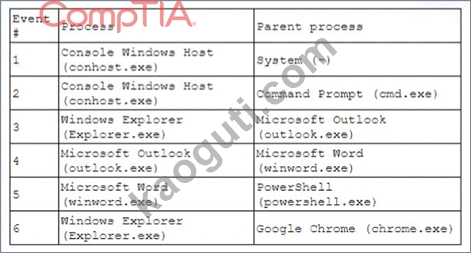
Which of the following has most likely occurred?
- A. A credential-stealing website was visited.
- B. An Office document with a malicious macro was opened.
- C. A web browser vulnerability was exploited.
- D. A phishing link in an email was clicked
答案:B
解題說明:
An Office document with a malicious macro was opened is the most likely explanation for the suspicious activity on the company laptop, as it reflects the common technique of using macros to execute PowerShell commands that download and run malware. A macro is a piece of code that can automate tasks or perform actions in an Office document, such as a Word file or an Excel spreadsheet. Macros can be useful and legitimate, but they can also be abused by threat actors to deliver malware or perform malicious actions on the system. A malicious macro can be embedded in an Office document that is sent as an attachment in a phishing email or hosted on a compromised website. When the user opens the document, they may be prompted to enable macros or content, which will trigger the execution of the malicious code. The malicious macro can then use PowerShell, which is a scripting language and command-line shell that is built into Windows, to perform various tasks, such as downloading and running malware from a remote URL, bypassing security controls, or establishing persistence on the system. The log excerpt shows that PowerShell was used to download a string from a URL using the WebClient.DownloadString method, which is a common way to fetch and execute malicious code from the internet. The log also shows that PowerShell was used to invoke an expression (iex) that contains obfuscated code, which is another common way to evade detection and analysis.
The other options are not as likely as an Office document with a malicious macro was opened, as they do not match the evidence in the log excerpt. A credential-stealing website was visited is possible, but it does not explain why PowerShell was used to download and execute code from a URL. A phishing link in an email was clicked is also possible, but it does not explain what happened after the link was clicked or how PowerShell was involved. A web browser vulnerability was exploited is unlikely, as it does not explain why PowerShell was used to download and execute code from a URL.
問題 #241
An organization has noticed large amounts of data are being sent out of its network. An analyst is identifying the cause of the data exfiltration.
INSTRUCTIONS
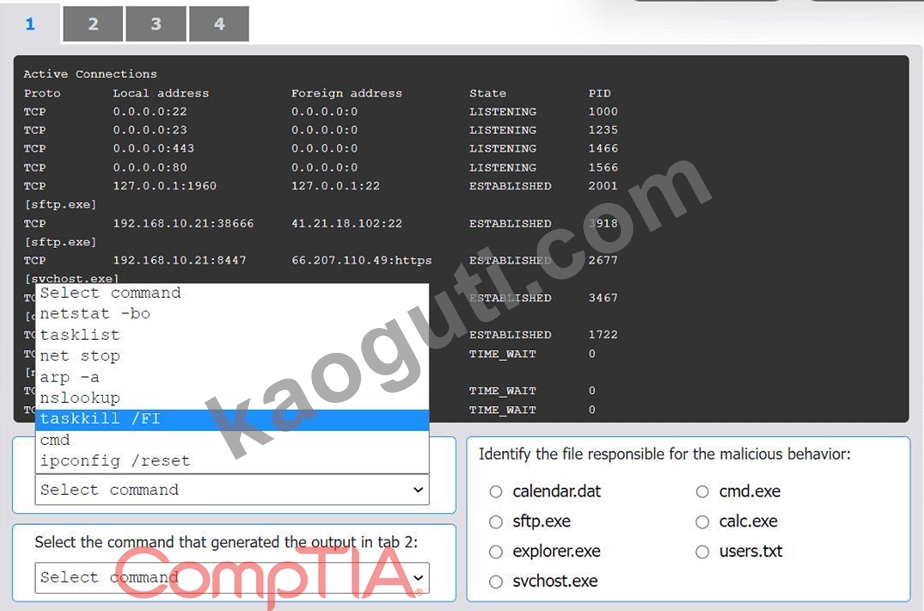
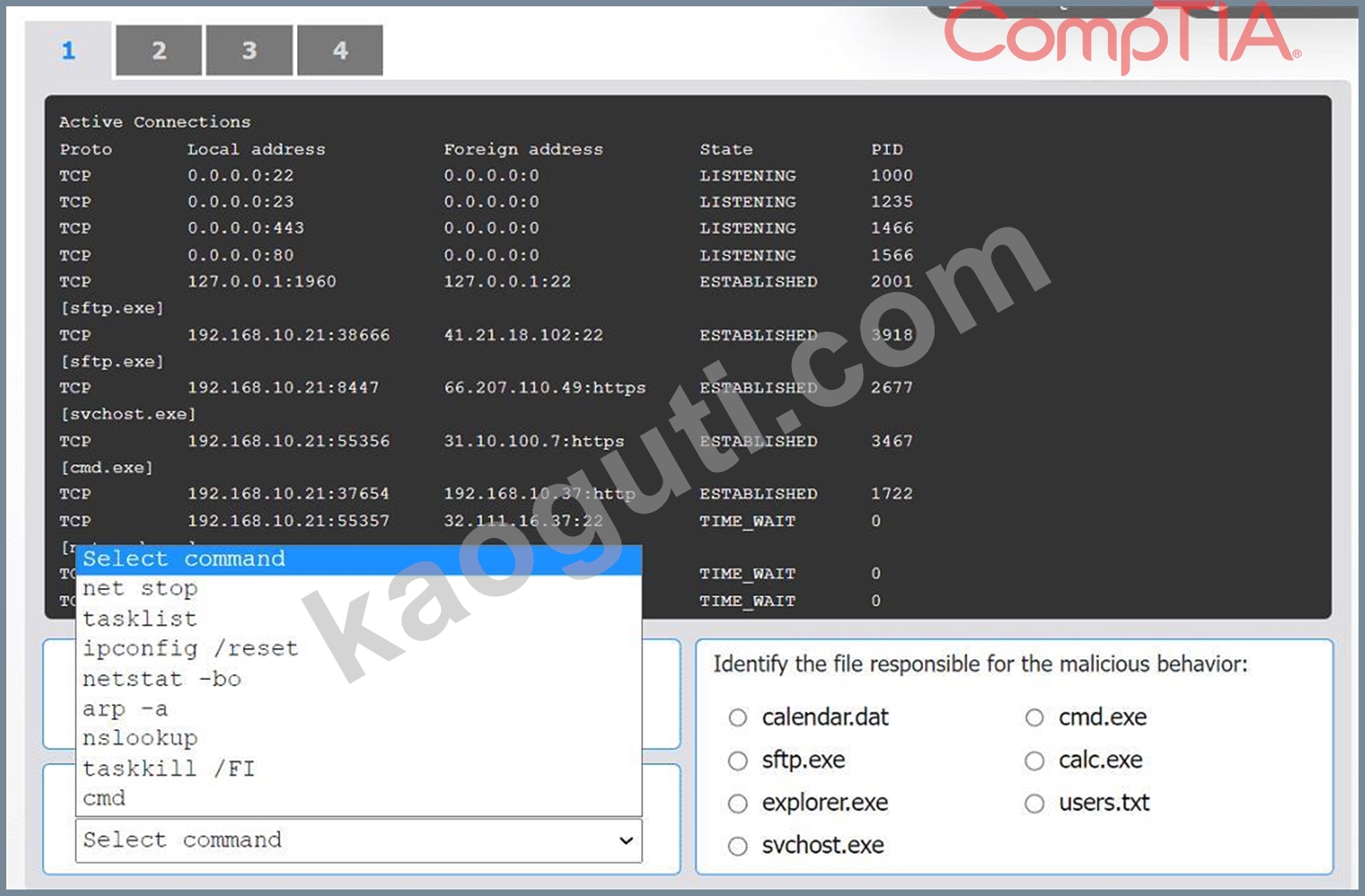
Select the command that generated the output in tabs 1 and 2.
Review the output text in all tabs and identify the file responsible for the malicious behavior.
If at any time you would like to bring back the initial state of the simulation, please click the Reset All button.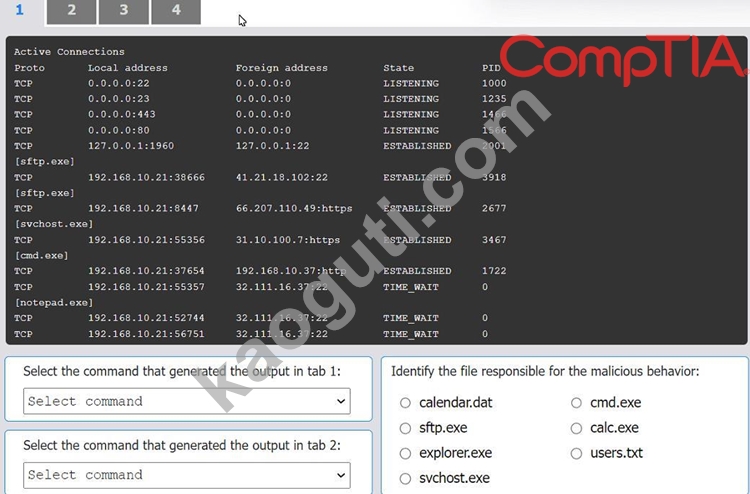
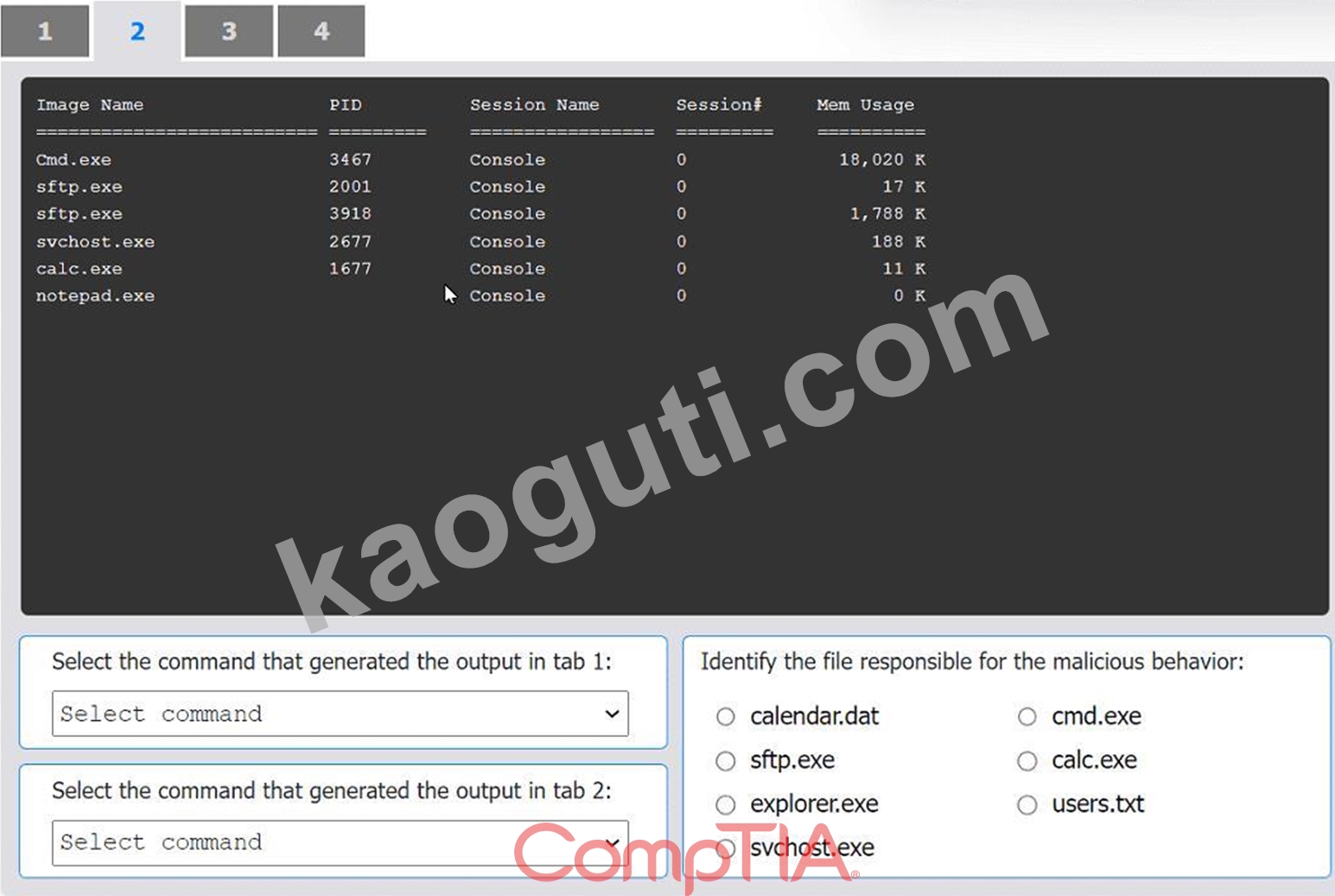
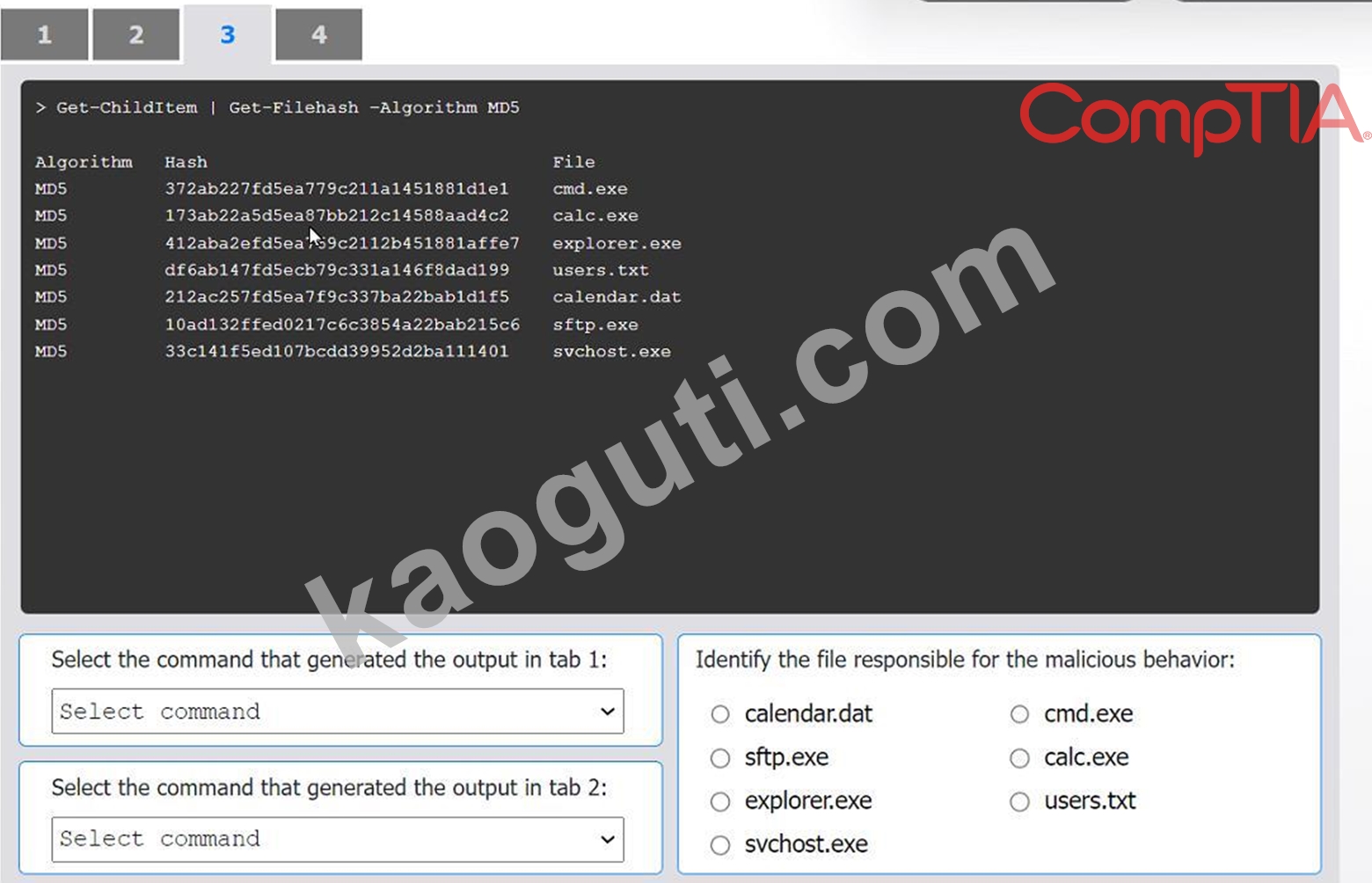
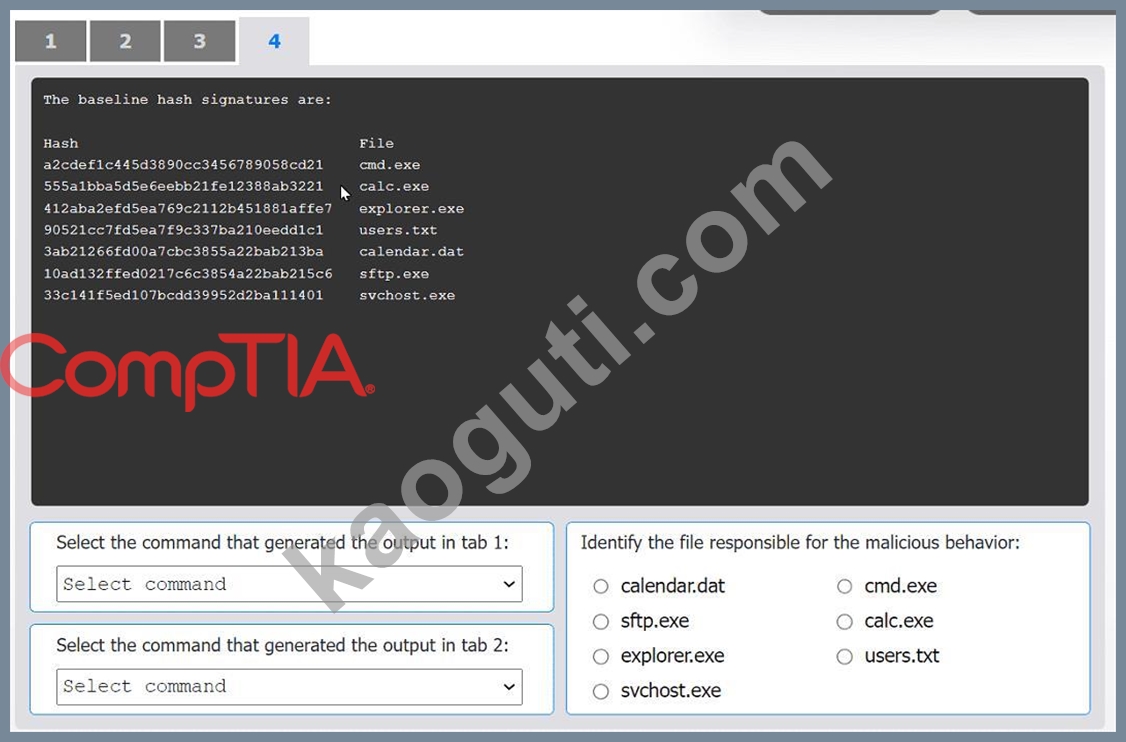
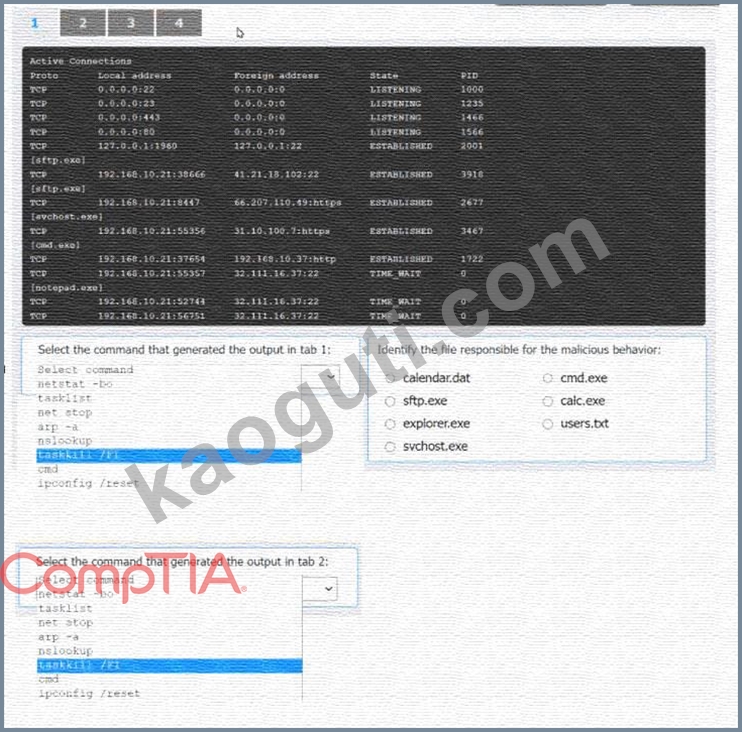
答案:
解題說明: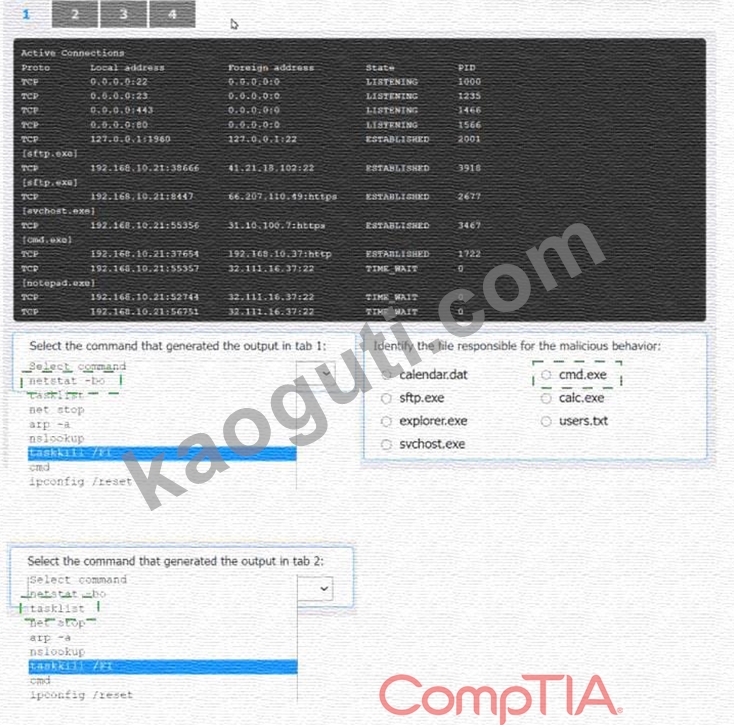
Explanation:
Select the command that generated the output in tab 1:
* netstat -bo
Select the command that generated the output in tab 2:
* tasklist
Identify the file responsible for the malicious behavior:
* cmd.exe
Select the command that generated the output in tab 1: The output in tab 1 displays active network connections, which can be generated using the netstat command with options to display the owning process ID.
Select the command that generated the output in tab 1:
* netstat -bo
Select the command that generated the output in tab 2: The output in tab 2 lists the running processes with their PIDs and memory usage, which can be generated using the tasklist command.
Select the command that generated the output in tab 2:
* tasklist
Identify the file responsible for the malicious behavior: To identify the malicious file, we compare the hashes of the current files against the baseline hashes. From the provided data:
* The hash for cmd.exe in the current state (tab 3) is 372ab227fd5ea779c211a1451881d1e1.
* The baseline hash for cmd.exe (tab 4) is a2cdef1c445d3890cc3456789058cd21.
Since these hashes do not match, cmd.exe is the file responsible for the malicious behavior.
問題 #242
SIMULATION
A company recently experienced a security incident. The security team has determined a user clicked on a link embedded in a phishing email that was sent to the entire company. The link resulted in a malware download, which was subsequently installed and run.
INSTRUCTIONS
Part 1
Review the artifacts associated with the security Incident. Identify the name of the malware, the malicious IP address, and the date and time when the malware executable entered the organization.
Part 2
Review the kill chain items and select an appropriate control for each that would improve the security posture of the organization and would have helped to prevent this incident from occurring. Each control may only be used once, and not all controls will be used.
If at any time you would like to bring back the initial state of the simulation, please click the Reset All button.
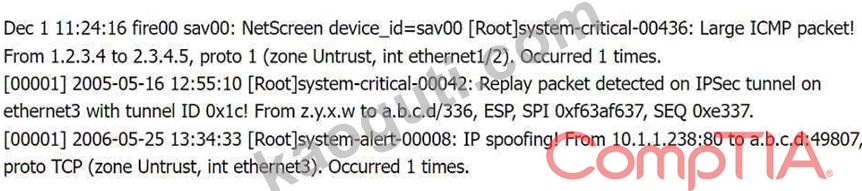
Firewall log: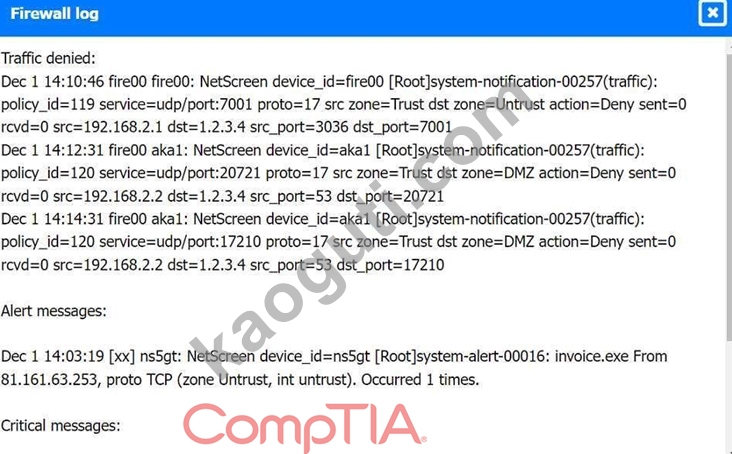
File integrity Monitoring Report: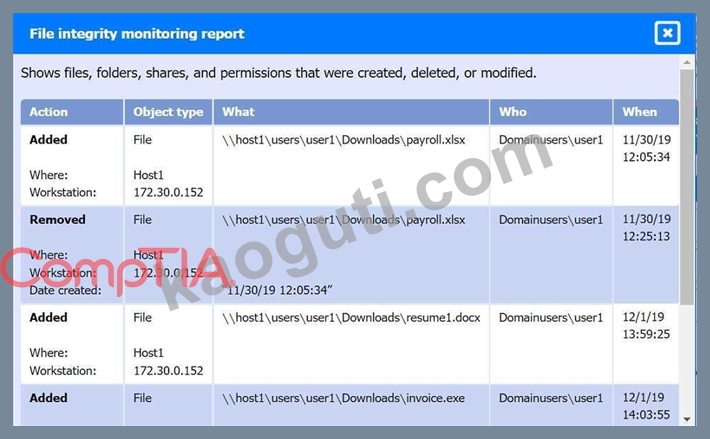
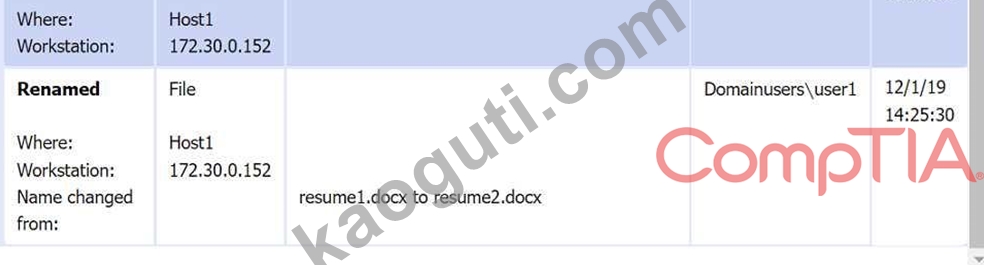
Malware domain list: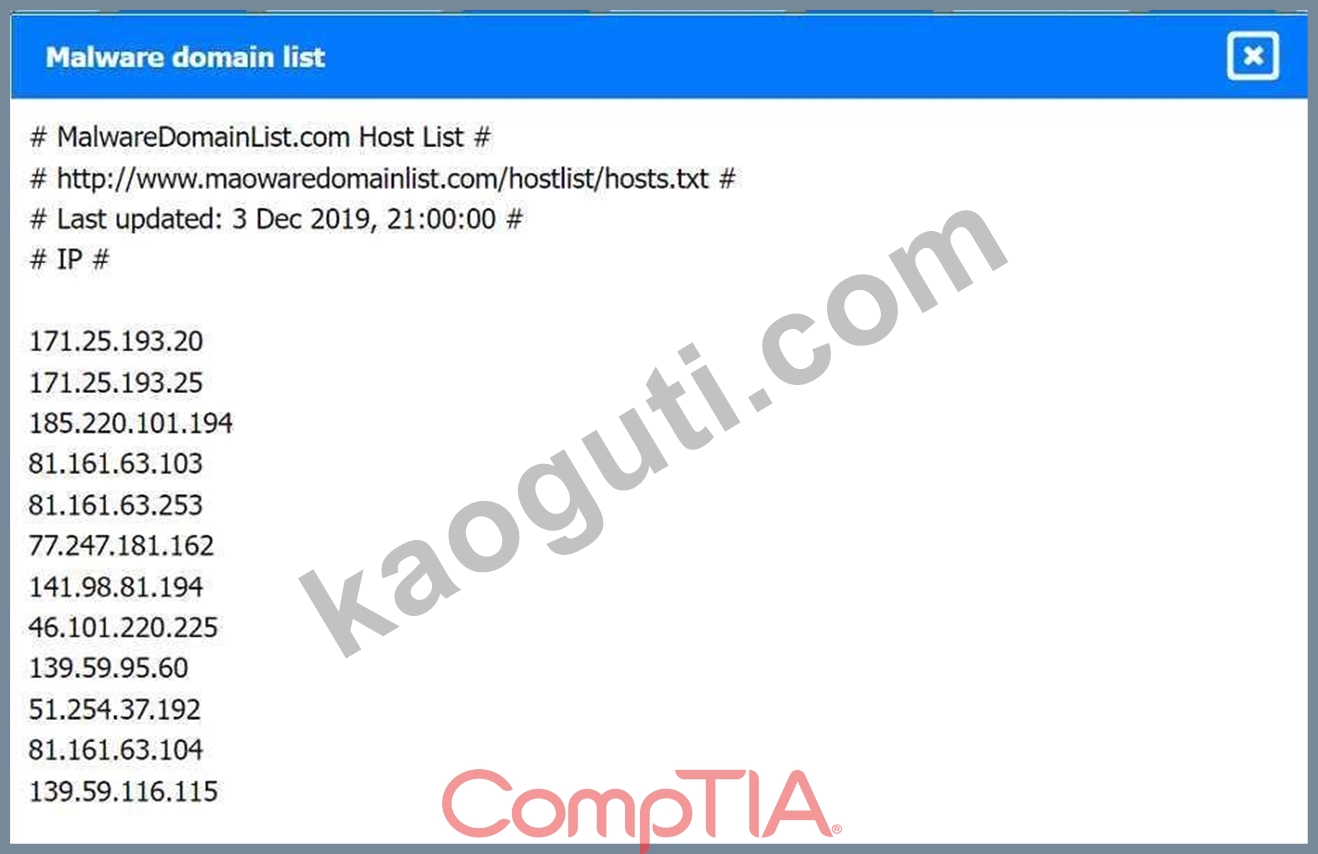
Vulnerability Scan Report: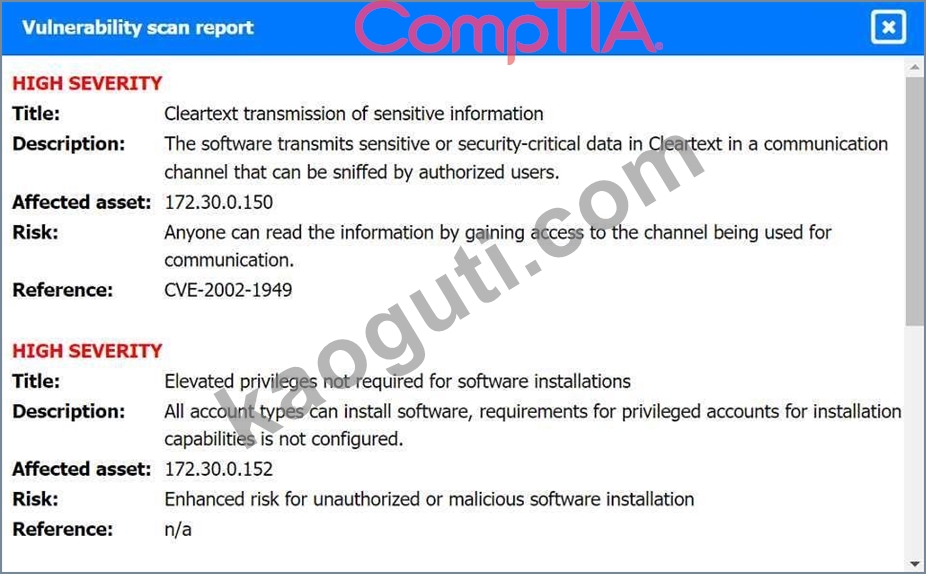
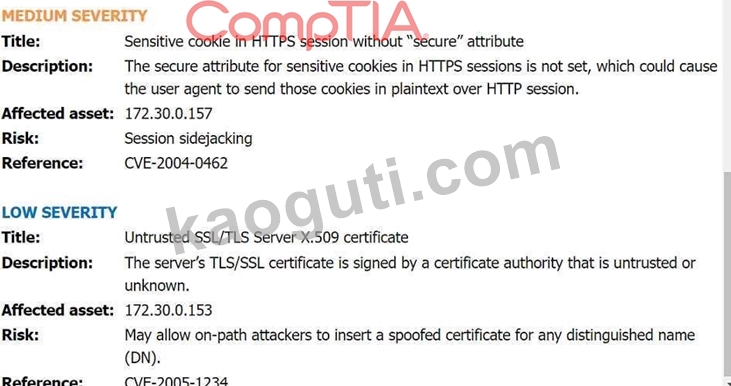
Phishing Email: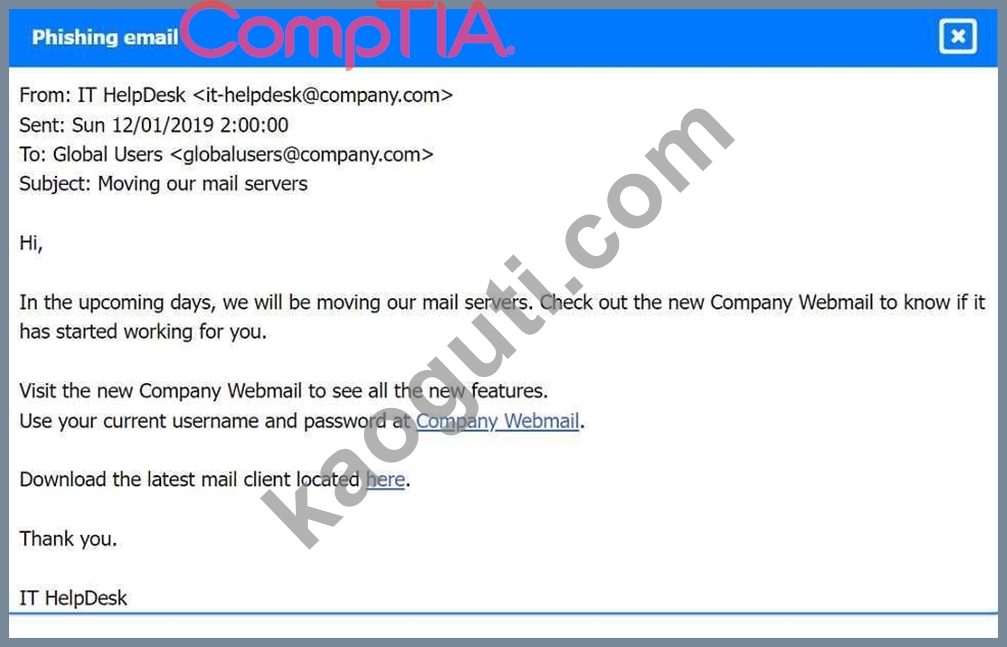
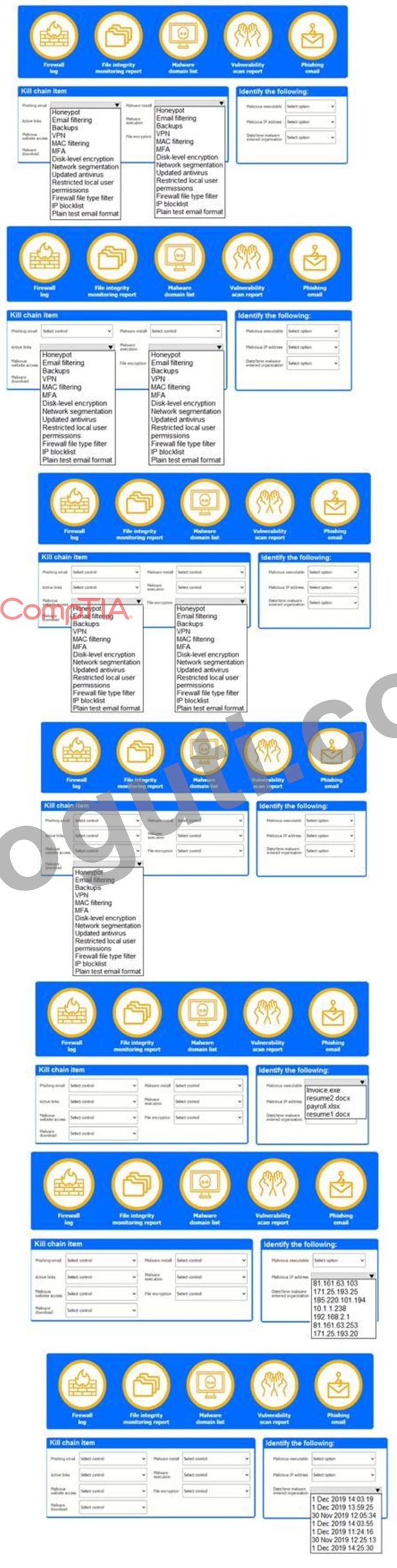
答案:
解題說明: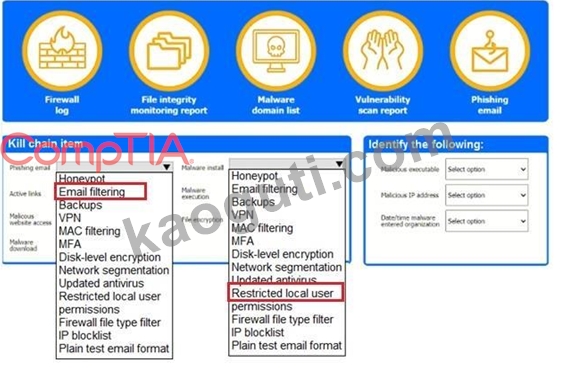
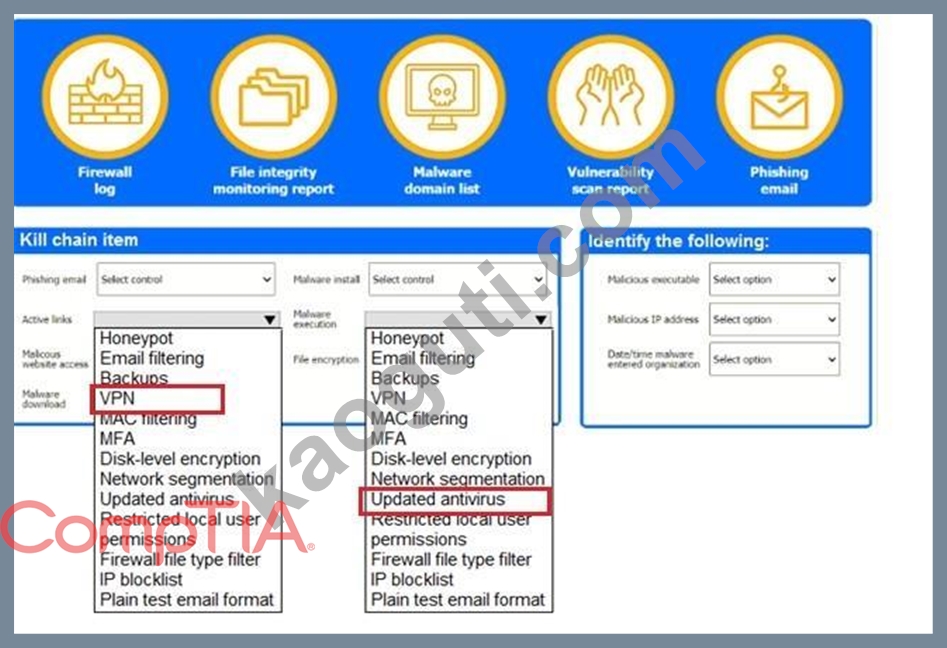
Kill Chain Item:
Phishing email - Email filtering
Active links - VPN
Malicious website access - IP blocklist
Malware download - Firewall file type filter
Malware install - Restricted local user permissions
Malware execution - Updated antivirus
File encryption - Backups
Identify the following:
Malicious executable - Payroll.xlsx
Malicious IP Address - 81.161.63.103
Date/time malware entered organization- 1 Dec 2019 14:03:19
問題 #243
A security analyst performs various types of vulnerability scans. Review the vulnerability scan results to determine the type of scan that was executed and if a false positive occurred for each device.
Instructions:
Select the Results Generated drop-down option to determine if the results were generated from a credentialed scan, non-credentialed scan, or a compliance scan.
For ONLY the credentialed and non-credentialed scans, evaluate the results for false positives and check the findings that display false positives. NOTE: If you would like to uncheck an option that is currently selected, click on the option a second time.
Lastly, based on the vulnerability scan results, identify the type of Server by dragging the Server to the results.
The Linux Web Server, File-Print Server and Directory Server are draggable.
If at any time you would like to bring back the initial state of the simulation, please select the Reset All button. When you have completed the simulation, please select the Done button to submit. Once the simulation is submitted, please select the Next button to continue.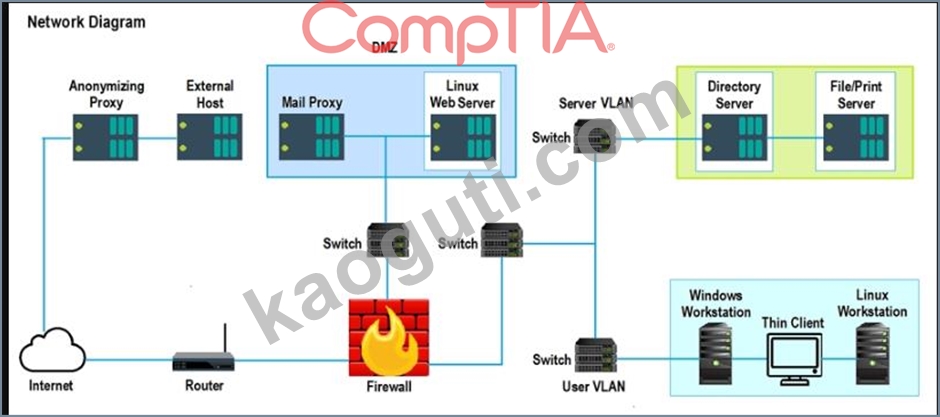
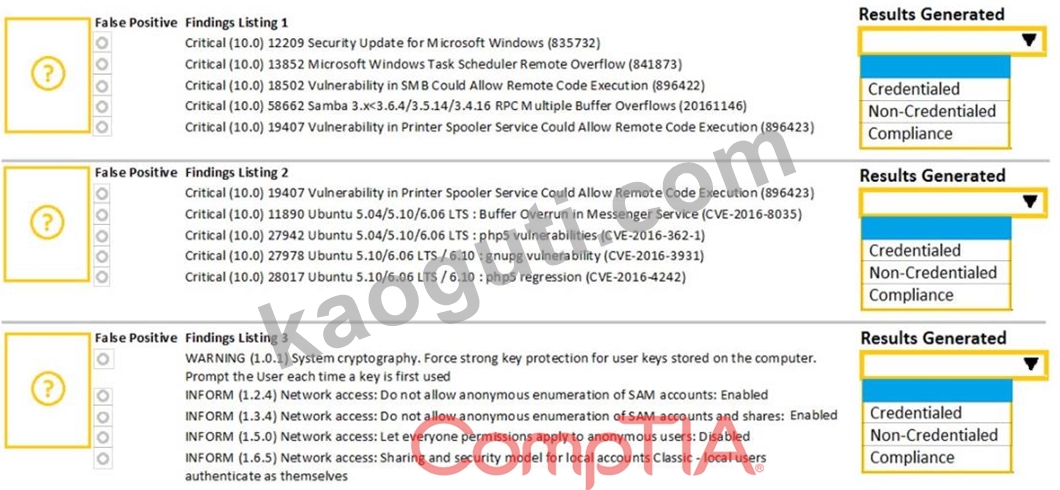
答案:
解題說明: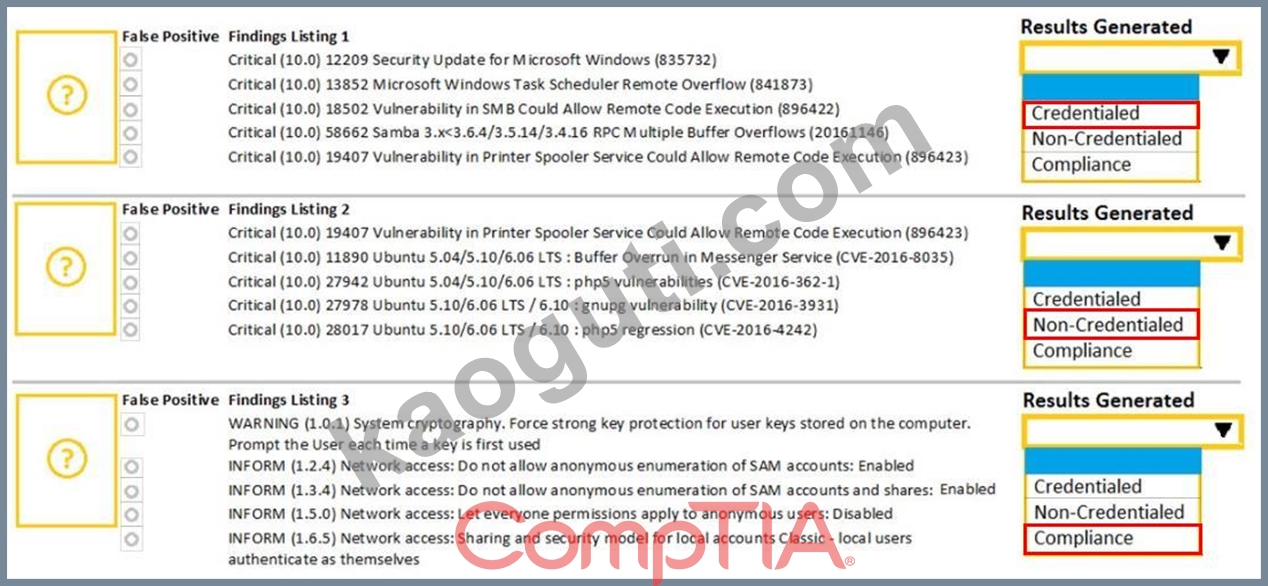
問題 #244
An attacker has just gained access to the syslog server on a LAN. Reviewing the syslog entries has allowed the attacker to prioritize possible next targets. Which of the following is this an example of?
- A. Passive network footprinting
- B. Application versioning
- C. Service port identification
- D. OS fingerprinting
答案:A
問題 #245
......
如果你的預算是有限的,但需要完整的價值包,不如嘗試一下我們KaoGuTi CompTIA的CS0-003考試培訓資料。我們KaoGuTi可以為你的IT認證保駕護航,是目前網路上最受歡迎的最可行的培訓資料網站,CS0-003考試是你職業生涯中的一個里程碑,在這種競爭激烈的世界裏,它比以往任何時候都顯得比較重要,我們保證讓你一次輕鬆的通過考試,也讓你以後的工作及日常工作變得有滋有味。還可以幫你挖掘到許多新的途徑和機會。這實在對著起這個價錢,它所創造的價值遠遠大於這個金錢。
CS0-003熱門考題: https://www.kaoguti.com/CS0-003_exam-pdf.html
- 高質量的最新CS0-003考題助您高效率地成功考過CompTIA CS0-003 ???? ☀ www.pdfexamdumps.com ️☀️是獲取➤ CS0-003 ⮘免費下載的最佳網站CS0-003熱門認證
- 高質量的最新CS0-003考題助您高效率地成功考過CompTIA CS0-003 ???? 進入➠ www.newdumpspdf.com ????搜尋➽ CS0-003 ????免費下載CS0-003考試備考經驗
- 準確的最新CS0-003考題和認證考試的領導者材料和最優質的CS0-003熱門考題 ???? 到[ tw.fast2test.com ]搜索▛ CS0-003 ▟輕鬆取得免費下載CS0-003考試內容
- CS0-003權威考題 ???? CS0-003熱門證照 ???? CS0-003考古題分享 ???? ➡ www.newdumpspdf.com ️⬅️上的⮆ CS0-003 ⮄免費下載只需搜尋CS0-003信息資訊
- 最新CS0-003考題:CompTIA Cybersecurity Analyst (CySA+) Certification Exam考試,CompTIA CS0-003—100%免費 ???? 請在✔ www.pdfexamdumps.com ️✔️網站上免費下載▛ CS0-003 ▟題庫CS0-003最新考證
- CS0-003考試內容 ⛷ CS0-003软件版 ???? CS0-003考古題分享 ???? 到{ www.newdumpspdf.com }搜尋▷ CS0-003 ◁以獲取免費下載考試資料CS0-003熱門認證
- CS0-003最新考證 ???? CS0-003熱門證照 ⤵ CS0-003測試題庫 ???? 到➠ www.newdumpspdf.com ????搜尋( CS0-003 )以獲取免費下載考試資料CS0-003考題套裝
- CS0-003權威考題 ???? CS0-003考題資源 ⬇ CS0-003考試內容 ⏰ 立即到➡ www.newdumpspdf.com ️⬅️上搜索「 CS0-003 」以獲取免費下載CS0-003考題資源
- CS0-003熱門認證 ???? CS0-003真題材料 ???? CS0-003软件版 ⏲ [ www.vcesoft.com ]最新⏩ CS0-003 ⏪問題集合CS0-003考題資訊
- 高質量的最新CS0-003考題,免費下載CS0-003考試資料幫助妳通過CS0-003考試 ???? 複製網址「 www.newdumpspdf.com 」打開並搜索➤ CS0-003 ⮘免費下載最新CS0-003題庫
- 信任www.newdumpspdf.com中的授權的最新CS0-003考題是通過CompTIA Cybersecurity Analyst (CySA+) Certification Exam的有效方式 ???? ➠ www.newdumpspdf.com ????網站搜索▷ CS0-003 ◁並免費下載CS0-003最新考證
- declanilvg029955.bloggip.com, bookmarkunit.com, kathrynxgrg337435.blog-gold.com, laytnikir102792.izrablog.com, blakejlvi970632.blogsvila.com, aadamlelv672781.bloggerchest.com, deaconvqvx327817.ssnblog.com, marclily245364.wikiworldstock.com, aadamsudh707045.bloggerbags.com, www.stes.tyc.edu.tw, Disposable vapes
BONUS!!! 免費下載KaoGuTi CS0-003考試題庫的完整版:https://drive.google.com/open?id=1ryIfH_ioNUJj1uwwetoPh4Joz_tLOcoU
Report this wiki page